
Cade or bottle-fed lambs can be the bane of a shepherd’s life, though for the new sheep keeper there is the wonderful novelty of training a newborn lamb to suckle from a bottle, the problem is that after 4 or 5 weeks the novelty definitely palls.
After more than fifteen years of keeping Southdowns and a few years in my youth with commercial sheep and a particularly frustrating time one year when the very last ewe to lamb had no milk, I thought it might be helpful to share my thoughts and experiences.
Be prepared, it will happen to you
Do everything you can to avoid having cade lambs... speak stiffly to the ewes and tell them not to have triplets. If the ewe is unlikely to have enough milk for two think twice about keeping her, and/or consider tupping her earlier when ovulation rates are lower (and certainly don’t give her PMS).
If at all possible scan the ewes, at least you will be prepared for the inevitable. Sadly, Sod’s Law dictates that the ewe with triplets will not lamb at a convenient time to foster onto another ewe with a single, or vice versa. And then even if you are lucky enough for the births to coincide, there are two more irritations, firstly than the lambs are mismatched in size and then the adopting ewe is a cantankerous old bat.
Nevertheless, if possible, foster the cade lamb onto another well-mannered and loving ewe with a single or no lamb at all. In my youth I have skinned dead-lambs - the old shepherds way - but I am way too squeamish to do that now but I will wet foster (using the birth fluids/after birth from a newly lambed ewe with a single to create her smell on the extra lamb) this usually works well if done promptly around her lambing and the fostered lamb has a bit of but not too much oomph… any teat will do and the ewe is pretty confused immediately after lambing.
So, on the basis that it will happen, have a small bag of powder milk ready to hand because you will suddenly want some at 6pm on a Saturday when the local country store is shut. And of course, do have some powdered colostrum to hand. When newly born1 if they are not on the mother (or I am too tired and knackered to crawl around in the lambing box teaching them to suck), I usually give two feeds with a tube, one fairly promptly and another 4-6 hours later, tho’ I like the mother to have had a chance to give it a good lick and hopefully the lamb to suckle properly. If they are going onto a bottle, then gradually migrate over one or two feeds to milk powder.
What about triplets
Normally triplets will need to be hand reared or fostered. Out of 60 or so triplet births, I can recall only two occasions when the mother has successfully reared all three. My default option is nearly always to take off one lamb tho’ with milkier ewes I may leave them with the mother for 4 or 5 days (lightly topping up) before taking one way. Another dilemma is which lamb to take, textbooks usually say take the biggest. I am afraid I use common sense: I avoid bottle feeding a ram lamb, he could be a nightmare when he is mature and if it has to be a ram then he will be castrated. Normally my preference is to bottle feed a ewe lamb: she may be a helpful flock leader/ bucket follower in later life, and as I can be a bit of a softy, it is less likely that she will have go to the butcher. The other important factor to consider is whether the lamb is a good sucker. Always choose the best bottle sucker!
Bed and Breakfast
Key things to consider
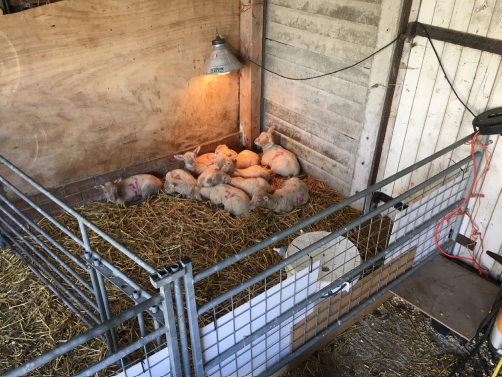
Clean sterilised pen at the start. Mine are pressure-hosed then a week or so before lambing I will spray them down with a disinfectant (Virkon S) and leave it to dry. (Actually to be honest I often leave it until the last minute i.e. when the first ewe has lambed!)
Access to fresh water, change every day or so.
Access to creep and hay/dried/ fresh grass from very early/ in the first 10 days. They will probably waste it... but having some non-milk food in their diet by week 3-4 should reduce the risk of bloat. Use dust free wood shavings to start, with extra straw/hay to chew on too.
Depending on weather, a heat lamp about 1.25m above them (you don’t want to roast or dehydrate them) in the corner of pen for the first 5 days or so.
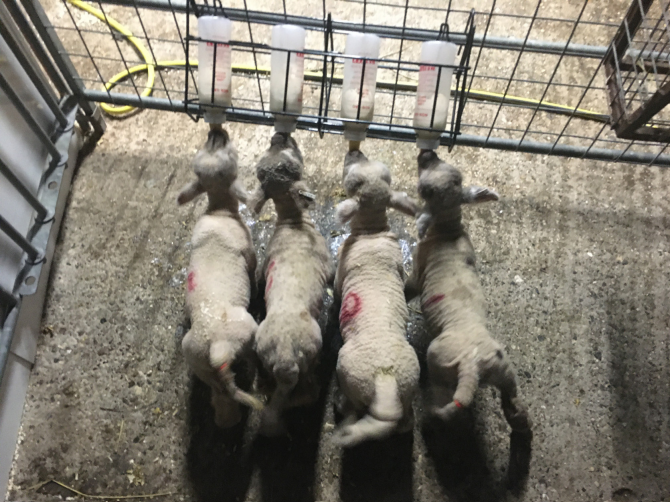
When feeding resist the temptation to make the teat hole very big to get the job done faster; feeding too fast will increase the risk of bloat.
A bottle rack can make life a lot easier but may need supervision.
Different Approaches
If you have a reasonable number of ewes in all probability in most years you will end up with three or more cade lambs. At this point you will need to have a word with your accountant because these lambs are going to cost a lot more time and money to rear.
I have tried 2-3 different approaches over the years:
Get someone else to rear them ... do agree a fee and arrangements in advance if you want to retain them, and importantly agree the vet protocol (I got caught out one year with a large vet’s bill for a weekend call out to treat pneumonia). I have never sold them but there is also a market for cade lambs. To date I have not found anyone who can reliably do it year in year out so I have had to accept the dubious responsibility myself.
Bottle feeding... this can work for 1-4 lambs but is a time commitment especially if there are two lambing batches. And once you get beyond four it becomes a bit of a juggling act, and quite exhausting. The milk powder bag usually says 1 litre of milk2 spread over four feeds. This is probably based on a 4kg lamb. Often the cade and/or Southdown lamb maybe only 2.5kg so I usually start them with 150-200ml 5 times a day, and gradually wind them up to 4 feeds of 250ml. In more recent years when they are about 3 weeks old, I change the regime to 350ml/feed and do three feeds a day.
The next step up is the Shepherdess feeder. This costs about £250, but it is possible to make your own version with some teats, tubing non-return valves and a large bin. The Shepherdess claims to feed about 20 lambs but I have usually only needed to do 8-12 lambs. The feeder comes with a water heater to maintain milk at the right temperature, but after advice from other experienced sheepkeepers I have never used the heater... for several good reasons, lambs don’t guzzle as much milk when it’s cold, warmed milk goes off more quickly, the heater creates a lovely bacterial brew in the insulating water, supplying electricity is another fiddly job and it’s already slightly awkward to remove the inner bucket without having to worry about the insulating water or the heater.
The other downside of the Shepherdess, apart from the foul job of cleaning it, is that the lambs drink twice as much milk as they would do normally. The lambs do look good, but I don’t think it does their liver any good and you certainly end up using a lot of milk powder. So, in latter years I ensure the feeder has enough milk in it at the beginning of the day to give each lamb 1 litre a day and then at night top it up with the equivalent of 0.5litre/lamb. Over two or three days some of the milk powder will sediment out so I will add some extra water and give it an extra swirl with a whisk.
Getting the lambs to drink from the Shepherdess is quite easy. In the morning - after a week or so of bottle feeding - I will give them one last feed of warm milk and then with a full tum switch them over to the Shepherdess as they are so greedy by this age they carry on guzzling and adjust to a new teat at a different angle with cold milk quite quickly.
The Shepherdess comes with the standard pink and white teats, not sure there is really much difference between the teats – I think the white is “softer” – either way do check them after 4-5 weeks as lamb’s teeth are mighty sharp and you will find bits of teat have gone missing.
Ideally the kit needs to be cleaned/washed out fairly regularly, but in cooler weather I may leave it for up 10 days, it depends on the smell, but I do rinse through the milk buckets fairly regularly.
Weaning at last
By 42 days old the lambs will be eating a respectable amount of solid food, so give or take a day or two, they will be off the bottle/shepherdess pretty promptly. Kept in a group and fed separately for 2-4 weeks in a paddock before being put with the main flock. It’s quite amusing - and a huge relief at a job well done - watching them sunbathing, still in a communal lamb heap next to a trough on a warm spring day.
And finally some nuggets
There are some large totally automatic commercial lambing feeding machines such as the Milkmade that can feed 150 lambs at a time; these cost several thousand pounds and are suitable for large commercial farms
Milk powder; I have switched to one based on ewe’s milk, it’s made in Eire and it is a bit more expensive but it “feels” right and mixes pretty well.
Do protect your milk powder from mice, they love it but there is no market for fat mice.
Use dust free wood shavings in your lambing boxes, much more absorbent and easier to clean out and softer than straw.
Use dried grass (the stuff for horses) to help get lambs started on eating forage.
Bloat in bottled lambs. It has happened to me more often than I like. If you can, slow the feed down so they don’t suck into much air. Make sure they have access to solid food: coarse mix/ewe nuts and hay/dried grass. And if necessary treat with bicarbonate of soda-I use about 1/4teaspoon in 50ml of warm water and tube it in. It’s not very precise but does seem to work. The tube itself may also help release some gas too.
Scour – it happens sometimes. I do my best to ignore and let it work through the animal but if it does seem to be going backwards it will be hoicked out for 24 hours (perhaps with a mate) and given water and an electrolyte to help tackle dehydration before returning to the group.
I am sure this is not an exhaustive list and there will be many more experienced bottle feeders than me, but so little of the nitty-gritty of sheep keeping is ever written down – it’s all word of mouth. Please, if you have some other tips to add on looking after cades, do drop Gail a line and share the knowledge.
Patrick Goldsworthy MBE
Webb Ellis and Heritage Flocks
Notes
1: Unless I am off to bed, I will wait about half an hour after the lamb is born before weighing the lamb and dipping the navel in iodine. I also use a pair of stationary scissors to snip off any long straggly bits of umbilical cord.
2: The instruction on some of the milk powder bags can be a bit confusing: often they say give a lamb in 1 litre a day in 4 feeds; they then suggest mixing up 250g powder in 1 litre of water… if you do a volumetric measure you find that works out a bit more than 1 litre!
