Having one flock of the slightly smaller type of Southdown, I am sometimes contacted by people keen to buy Babydolls or Babydoll Southdowns. My heart sinks when I hear the term “Babydoll“ as, frankly, I loathe this American term, especially as it is used elsewhere for dubious purposes! So, early this summer I resolved to write this article, having written it and I thought I nailed it. I had an interesting conversation in September with new member Jonathan Gilpin who has both Babydolls and Southdowns. He has provided some interesting observations which are included. I would also like to thank Council colleague Tim Morris for his input on the trademark situation.
All Southdown Sheep worldwide originate from the UK’s Southdown which were bred in the 19th Century primarily in the South Downs and also in East Anglia where they were invaluable for “folding” (grazing root crops) as part of a green manure for following cereal crops. Because of the success of the breed and the influence of Britain in the 19th and early 20th century the Southdown was exported worldwide with particularly strong breeding programmes/exports to Australia and New Zealand but also other countries including France, America and Argentina.
In America some erstwhile Southdown breeders have introduced the concept of the “Babydoll” and that terminology has spread to the UK. To my mind, these are “dwarf” animals claiming origins from a small pool of selected American Southdowns. I am not sure whether they go “Hi Ho, Hi Ho”, go to work or have beards… but they are a real thing and, in some eyes, could be seen as a misuse of pedigree breeding techniques.
In North America there are no less than three Babydoll Registry organisations! The original privately owned Olde English Babydoll Southdowns Sheep Registry, The National Association of Babydoll Southdown Sheep Breeders Registry and, as there were “rows” between breeders (what a surprise!), a third newer organisation also exists: the Babydoll Sheep Registry Association (BSRA). This latter group has dropped Southdown from their name and wisely offers a fivegeneration pedigree. In theory the breed standards of all these registries are based on those in the Southdown Flock Book. However, there is in my view a rather eccentric, unnecessary additional breed standard relating to shoulder height as (short as 48cm) that I suspect will not be helpful to this group of animals in the long term… think of the issues with some dog breeds.
Babydoll in the UK
While some Brits may have imported sheep from North America, it is difficult to be sure if this is really the case. It is extremely difficult/well-nigh impossible and very expensive to import breeding stock from abroad (1). From Europe, it was already complicated but possible pre-Brexit, and still possible but even more complicated and via a very circuitous route post Brexit. Pre-Brexit due to conflicting health requirements between the EU and other countries it was effectively impossible to import from anywhere other than Europe. So, it is more likely that these Babydolls have been taken from the smaller end of existing UK breeding stock and then selected to comply with one of the American registry standards. It would be fascinating to see the extended pedigrees – going back to 2000 or before – of these sheep.
Size matters, or does it?
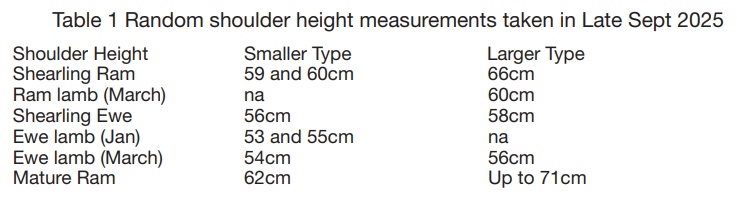
There is naturally considerable weight variation c. +/- 25% within Southdown and notably the Society’s official breed description makes no reference to size. It is important to remember that as well as genetics, feeding regime, age, condition and a large single vs small triplet can have a big effect on final size. While prepping some sheep for a local show I took the opportunity to measure a selection of shoulder heights. With the exception of a leggy Southern hemisphere type ram, there was not that much variation in shoulder heights between the two different types. I suspect a lot of what we see in the show ring may be wool, feeding, expert trimming and the apparent effect of width and height. i.e. I was taller and wider than my brother but because he was thinner, he looked taller!
Legislation on Breeds and Breed Societies
There is also UK and EU legislation about pedigree breeds which means the so-called BD Southdowns cannot be recognised as a unique breed in the UK with the Southdown name. There are also strict regulations to ensure there cannot be multiple breed societies for the same breed, and more recently a tougher stance on separating out sub-populations within breeds. So, a “Babydoll” Southdown is not and can’t be a registered Southdown unless it is in the Society’s flock book, and the same strict regulations also apply to register new breeds which, to date, have not been met for these sheep. A further factor to be considered is that the Southdown Sheep has a registered trademark: the Southdown Sheep Certification Mark, and anyone claiming that their “Babydoll” is a Southdown Sheep could be accused of misrepresentation by describing it as a “Babydoll” Southdown, if it is not registered with the Southdown Sheep Society.
Enjoy your Southdowns first, and make sure they are registered in the right Flock Book
Ideally all Southdowns should be registered in the Society flock book, however as we are all aware there are a great many Southdown owners who simply enjoy their sheep and don’t feel the need to register their stock. As regards “Babydolls” by all means, if you must, call it a “Babydoll”, but we should be quite confident telling people that a “Babydoll” may be based on a Southdown but that they should look at its pedigree, check where it and its parents are registered. Do their research and as always CAVEAT EMPTOR. And yes, it maybe that a smaller Southdown may be eligible to be registered in the American BD flock books if they meet their required breed standards.
Patrick Goldsworthy MBE
Webb Ellis and Heritage Flocks
Babydoll Origins in America
Whilst there have been Southdowns in America since the early 19th century, a Robert Mock started the first privately owned Babydoll registry in the United States in September 1991. Apparently, Mr Mock had a thing for miniature livestock of any kind and sheep were the only domestic breed of livestock, at the time, that didn’t have a miniature counterpart. He had first seen a Southdown in the 1980s but didn’t know what it was, just knew it was small. He started a search for these in the US, found some, and put together his registry. Probably because of his fascination with “miniatures” he named the registry the Olde English “Babydoll” Miniature Southdown Sheep Registry. It was then, and still appears to be, a privately owned registry. It seems the Babydoll term came about because it was cute and Mr Mock figured more sheep would sell. The more sheep registered and sold means more money in the pocket. Subsequently and separately NABSSAR a non-profit association and registry was formed in 2003.
The Babydoll Southdown are descendants of the Southdowns imported from the UK. However, Mr. Mock put the stipulation that they be 24” (61cm), or less, at the withers. However, an article he wrote in 1991 states the rams are no more than 26” (66cm) high. NABSSAR originally allowed sheep from 24” to 26” but they were discriminated against and in 2025, it changed this to only register sheep 18” to 24” (46-61cm) tall.
The original now larger Southdowns are now known as American Southdowns (American Southdown Breeders’ Association) and are considered a different breed to Babydolls. They are still bred as a terminal sire/meat sheep. The American Babydoll market is really for use as pets and wool, though are also used in orchards and vineyards, etc. Some Babydoll breeders considered their sheep to be closer to the size of the original Southdown. One breeder describes them, as a “regular sheep on short legs”, with adult rams weighing up to 90kg and mature ewes 65-75kg. That is fairly typical of the smaller end of the breed.
References
1 I understand that prior to or around 2000 there were some semen imports from Canada and New Zealand when exports and imports were a bit easier and theses were used for some of the UK foundation stock of Babydolls
