
Laura Eyles, Signet Breeding Services
Certain traits are more heritable than others and it’s all too easy for breeders to focus on the high heritability traits such as growth rate or muscle depth, but important improvements to maternal traits can also be made through ram selection.
The number of lambs reared per ewe is often a key driver of flock profitability, but simply selecting a ram because it was born as a twin will not guarantee increased prolificacy in his daughters.
Genetic influences on reproductive performance tend to be relatively small, while environmental influences have a massive impact – and as a result you should avoid making your decision based on a single piece of information.
Take these two rams as an example
Ram A – Born a twin, mother was a single and produced four singles in previous lambing events.
Ram B – Born a single, but its mother was born a twin. She goes on to produce four more sets of twins over the next four years.
Clearly, there is a greater chance that Ram B’s daughters will be more prolific when they become mothers as this breeding line appears to be more prolific.
Going a step further, breeders and ram buyers can use analysed data to help make breeding decisions. Selecting recorded rams with Estimated Breeding Values (EBVs) for important performance traits enables farmers to make more informed decisions based on a ram’s genetic merit, which is a better predictor of progeny performance.
The use of EBVs is especially import for maternal traits, such as litter size and maternal ability, where it is impossible to identify the best rams by eye alone. Using EBVs to select rams with positive litter size EBVs will increase the number of lambs produced by their female offspring. For example, a ram with an EBV of +0.06 is estimated to produce daughters which produce 3% more lambs than a ram with an EBV of 0.
High EBV Rams Increase Prolificacy by 3%
The value in using EBVs to aid selection compared to selecting on birth type alone is clearly shown in the table below, which shows data for 100 Southdown rams that have been recorded for prolificacy, i.e. they are sires with lots of daughters. The table shows their litter size EBVs broken down by their birth type and by their genetic merit for prolificacy (as determined by the Litter Size EBV). Within this dataset, selecting a twin born ram over a single born ram would result in daughters that are about 0.05% more prolific.
Selecting the 25% of the Southdown rams with the highest breeding values for litter size compared to those with lower values (over half of which were twins as it happens), would result in daughters that would be about 3% more prolific.
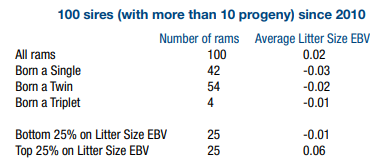
Table 1 Shows that there is little difference in litter size EBV when selecting rams simply based on birth type. However, when breeders use the Litter Size EBV in their selection, then greater gains can be made each year.
Take Home Message
Breeders and buyers are seeing the benefit of looking deeper into an animal’s background before purchase and investigating all aspects of the performance data to make informed decisions rather than buying on looks alone. An investment in high-performance genetics will increase flock productivity, which, in today’s ever-changing world, has never been more important.
If you would like to find out more, please contact laura.eyles@ahdb.org.uk
