
In the long twilight of my playing days and previously out of necessity when the ref did not appear, I refereed rugby matches and mostly enjoyed the experience. Was it an ego/ performance thing or just good to put something back into and be part of a sport I loved? Anyway, I am used to being in the middle and in charge as well as missing things, making controversial and even the wrong decision.
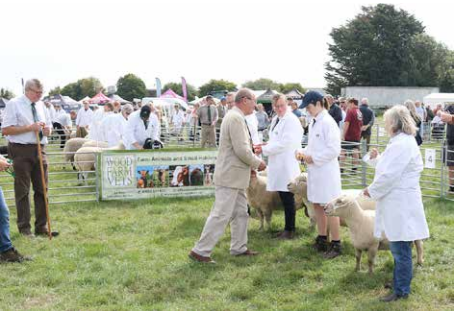
I am not an official Southdown Sheep Society judge, as tradition suggests that only breeders who have won multiple red rosettes and championships are deemed suitable candidates, though it can also seem to be a matter of knowing the right people. Anyway, I was rather flattered to be asked to judge (The only previous time I was a judge was in 1980 at the Seale Hayne annual panto: Toad of Toad Hall in which I sent Toad to prison for speeding and saying “Toot Toot” and interrupting court proceedings.) the Southdown Classes at two reasonably local shows in 2025... I think they might have been a bit desperate.
Those that know me, know that I don’t really enjoy showing and so I have only won a modest number of rosettes and certainly have been relieved to avoid the hanging around for an inter-breed championship. Having said that, as a member of Council I have attended one and hosted another judging workshop and these have provided valuable insights and made up for the fact that I (mercifully from my perspective) avoided “young farmers”, so I had missed out on all the training and traditions that go with the legendary – or apocryphal? - YFC partying.
Common Principles
Some principles are the same: good preparation, timely arrival, a helpful or otherwise touch judge/steward, and rules/laws and etiquettes to follow; however, many of the livestock judging rules/traditions are not written down; like so much of sheep keeping, it’s a lifelong apprenticeship learnt by doing and listening rather than reading. Fortunately, there are some judging notes available from the Society - which I added to prior to my first experience: my “Novice’s Aide Memoire” and is also my way of “revising”
As a referee the most important things for me was to make the experience enjoyable, fair and safe for everyone, whilst also reading the room and situation - old lags out for a rumble, fun and a beer or madly enthusiastic and highly competitive youngsters to whom winning is everything. I suspect that this can apply - in the main - to sheep-showing: some are Premier League events where some breeders are madly competitive, other shows are more relaxed with exhibitors just as happy for a day out and to talk sheep with likeminded lunatics!
Having only judged two local shows made up of six small classes it may be a bit soon to make too many comparisons. But here goes:
Timekeeping
Rugby matches have a kick off time and usually a unique pitch. Judging at shows means that kick off and the pitch/ ring can be a very movable feast. You are dependent on preceding judges, their classes and number of entrants. Then once you are on the pitch, sorry in the ring, you have to wait for exhibitors and their sheep some of whom are still fluffing their sheep. I never did it, but I so nearly have started a game at the allotted kick off time whether both teams were on the pitch or not… I did end games a bit early if we were late starting - nobody wants cold showers. You can tell I might be impatient! And certainly, when judging whilst being thorough and looking at every sheep, I was quite brisk especially as Southdowns seemed to be in the later groups and we were all getting hungry.
Communication
Another difference is that in rugby matches it’s important before the game to brief captains and key players on how you will referee and remind players (props especially whose memory was notably short) of their role. It is also important to manage the game ideally with a bit of light humour. However, show ring etiquette is that you barely talk to let alone smile at exhibitors - and certainly not beforehand. I am afraid at both shows my inner referee came out once exhibitors came in the ring if only to tell them what to do and what I was doing. For lamb classes I also felt it was only fair to ask which month the lamb was born in and if it is a single or a multiple. Gosh I hope exhibitors are honest…
Identification
Another challenge is being able to remember which sheep is which. At least rugby teams have different coloured shirts with numbers (Having said that there was one game where as a joke every single player had the Number 5 on their back!) on their back and players have set positions, so you know where to find the guilty party when you want to “have a word”. With my Southdown eye I can tell different flocks/styles apart but remembering individual sheep and their good and bad points in the show-ring is much harder. Which ewe had her teeth a bit too forward, which ram had the best gigot, whose gait was a bit wobbly, which lamb had poor wool. At the second show I realised that exhibitors had numbers on their sleeves which made things a bit easier!
Dress Code
Judges are meant to look smart and wear country tweeds and a suitable or eccentric hat (that does not blow off), stalk around the ring with a shepherd’s crook using it to select their class winner with an elaborate flourish. On balance I think I would rather wear my referee kit (except on v cold days) than a suit and tie. Having had to wear a tie from about the age of four, these days I mostly only wear ties at funerals, shorts are much cooler on summer days and give good ventilation to the nether regions. Nowadays a rugby refs’ shirt is usually acrylic so v easy to wash and does not need ironing, the shorts are short, baggy and have useful pockets.
Performance and Rituals
Another aspect I realised after thinking I had finished writing this article, was that in the roles of referee and show judge there is an element for the spectators of “performance”. As a referee I would wave my arms around giving signals that the cognoscenti may or may not have understood, likewise in the show ring the judge stalks up and down the sheep on parade, stepping back to admire, darting into check something and crowning the champion all part of the judge’s showmanship. Rituals are there too: checking certain key elements of each animal, teeth, feet, genitalia, gigot, wool and skin are somewhat similar in principle at least to the scrum or lineout set up – crouch -bind-set – and reminding players to keep their distance and the right numbers in the lineout. Patterns of behaviour that help remind both the judge and the participants of what is being done and ensuring a consistent approach.
Après Show/Game
As you may be aware social rugby often involves a lot of beer drinking, I am very much a drinking lightweight although I do enjoy my grub, I am also not too keen to have a long detailed discussion with an inebriated flanker as to why I repeatedly penalised him for being offside (he was offside and besides as the referee I was right), so usually after rugby matches I would grab the free pint of lime and soda, bolt the match tea and rapidly disappear. Judging at shows is an altogether different experience; judges are royally treated to a pretty good meal, and it has - so far - been really nice to wander around and talk to Southdown breeders and explain your thinking and any private observations you had on their sheep. One other thing that, as a judge I have been asked to do already, is to talk briefly over the showring microphone about your choices: “They were all excellent sheep, beautifully presented but “just for today” that one caught my eye.” It is also a great opportunity to promote the breed and it’s many excellent attributes.
A couple of final thoughts: firstly, please have some sympathy for the judge/referee – without a judge/referee – there is no game/no rosettes. They may not be perfect or get everything right, but they will all be doing the best they can to make sure things are fair, fun and hopefully ending up with the right result. And secondly, as a referee however experienced they are, there is at least an annual assessment by a knowledgeable colleague who would help – mostly tactfully - identify improvements. It is something I wonder if we should as Society consider formalising.
Patrick Goldsworthy MBE
Webb Ellis and Heritage Flocks
